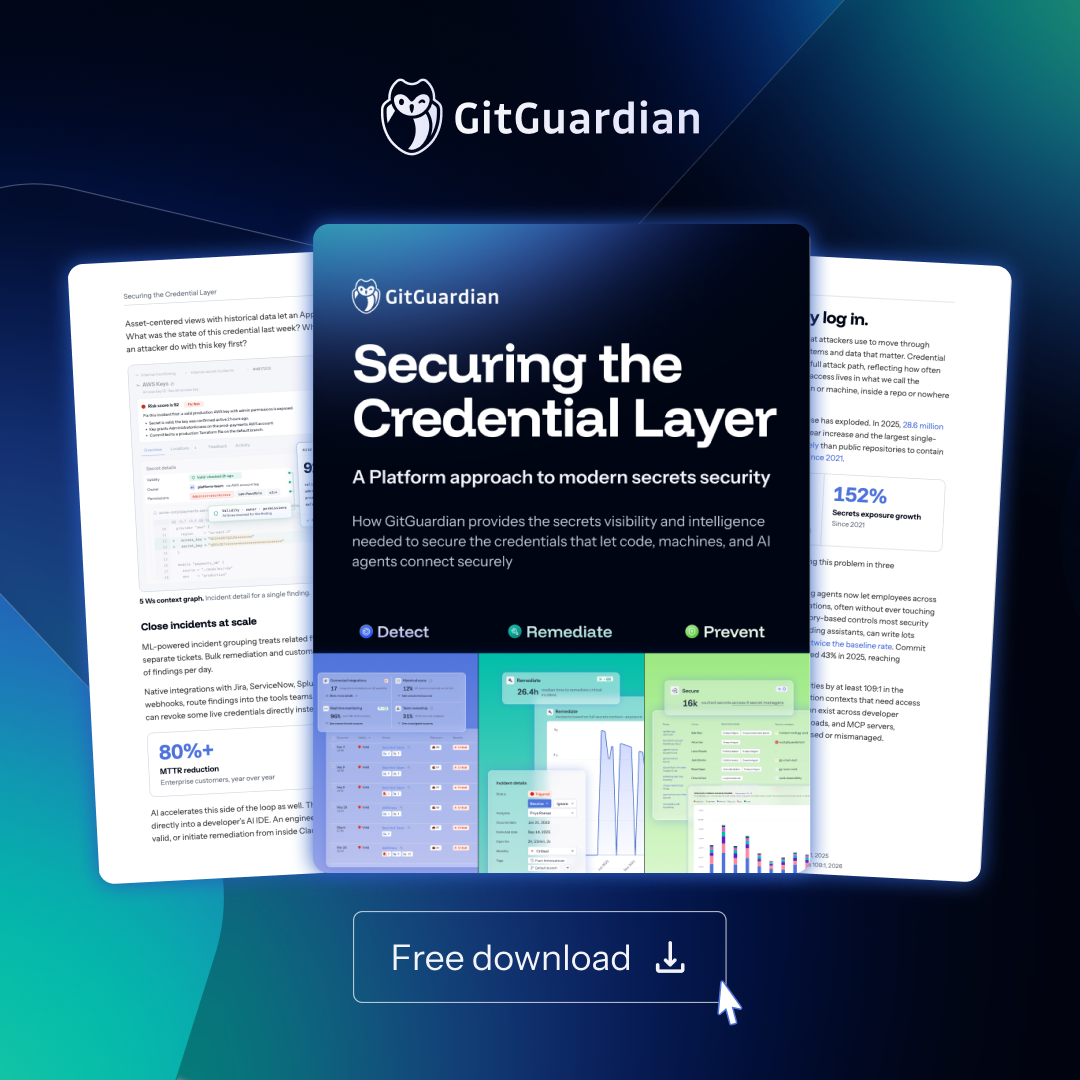
Securing the Credential Layer

White Paper Banner

Credentials sit at the center of modern breaches. They are what attackers use to move, escalate privileges, persist, and reach the data that matters, and AI-assisted development is multiplying how many exist, where they spread, and how far one over-permissioned agent can take them.

This whitepaper shows how GitGuardian closes the loop in three pillars. Detect finds credentials across source control, CI/CD, collaboration tools, developer laptops, and public GitHub. Remediate wraps each finding in the 5 Ws context graph and clears incidents in bulk. Prevent stops the next leak at the commit, on the endpoint, and inside the AI agent, and adds risk context to the identities behind them.

Download the whitepaper

Detect, remediate, and prevent as one loop

By submitting this form, I agree to GitGuardian’s Privacy Policy

Thank you! You will soon receive the white paper in your email.
Oops! Something went wrong while submitting the form.

Credentials sit at the center of modern breaches. They are what attackers use to move, escalate privileges, persist, and reach the data that matters, and AI-assisted development is multiplying how many exist, where they spread, and how far one over-permissioned agent can take them.

This whitepaper shows how GitGuardian closes the loop in three pillars. Detect finds credentials across source control, CI/CD, collaboration tools, developer laptops, and public GitHub. Remediate wraps each finding in the 5 Ws context graph and clears incidents in bulk. Prevent stops the next leak at the commit, on the endpoint, and inside the AI agent, and adds risk context to the identities behind them.

Detect, remediate, and prevent as one loop

Download now

Trusted by security leaders at the world’s largest companies

Summary

The credential layer your current stack can’t see

None of this happens in one place. A credential written into a developer’s .env file today can end up in a Slack thread tomorrow, and a public commit six weeks later. Vaults, AppSec platforms, non-human identity tools, and endpoint detection each see a slice of that path, and the gaps between them are where exposure persists.

GitGuardian is built to close those gaps: monitor every relevant surface for active credential exposure, investigate each finding in context, close incidents at scale, and stop new exposure at the source while securing the identities behind each credential.

In this whitepaper, you’ll learn:

  • How AI-assisted development is accelerating credential exposure in three distinct ways
  • Where the credential layer sits between your existing tools and why it has to be closed as a loop rather than one perimeter at a time.
  • How Detect sees credentials wherever they sit and turns monitoring into confirmed findings.
  • How Remediate uses the 5 Ws context graph (when, why, what, who, where).
  • How Prevent stops exposures at the source.
  • The importance of identity context for credentials outside governed systems.
  • What the GitGuardian platform provides for your role.

‍

White Paper Banner
White paper page preview
Left arrow
Right arrow