

GitGuardian for CISOs
Turn credential exposure into a program you can measure, prove, and defend.

.svg)



.svg)

Security leaders running mature security
programs choose GitGuardian
"GitGuardian lets us analyze the entire GitHub perimeter including developers' personal repos outside our control.”

"Prevention is the game changer. A secret that's not exposed poses no security risk and requires no remediation.”

“An extremely low amount of noise and false positives. GitGuardian gives us a signal our team can act on.”

Five pressures shaping credential
security programs
AI has expanded the attack surface
Machine identities outnumber humans 109:1, and AI assistants create credentials faster and across more environments than traditional controls can govern. 64% of secrets leaked on public GitHub in 2022 are still valid today. Mean time to exploit: 60 days in 2018, -7 days in 2026 (Mandiant). The clock has flipped. The challenge shifted from finding secrets to controlling exposure at scale.
.svg)
Attackers log in with credentials your existing tools can't see
Vaults protect what's inside them. EDR catches malicious processes. IAM governs human logins. None of them find credentials that leak into developer laptops, personal repos, AI agent caches, or Slack.
The board wants proof that risk is going down
Finding more secrets does not mean your program is getting stronger. With valid-credential breaches now averaging $5.07M, CISOs need measurable improvement: fewer exposed credentials, faster remediation, clearer ownership, shorter exposure windows. Those are the trends boards understand as resilience.
Credential governance is becoming an audit requirement
SOC 2, ISO 27001, PCI DSS 8.6.2, DORA, and NIST 800-53 all now scrutinize credential and machine-identity controls. Auditors and cyber insurers want evidence you can discover, govern, and remediate exposure, not just store it in a vault.
Your credential strategy has to work with the stack you already have
EDR, IAM, vaults, and AppSec tools remain essential. The missing piece is visibility and control across the credential exposure those systems leave behind, without creating another isolated workflow or dashboard for your team to manage.

The credential layer security platform
Get continuous visibility across every credential surface. Validate exposures, identify ownership, prioritize risk, and drive remediation, with a complete audit trail. Built to work alongside your existing security stack.
How GitGuardian helps CISOs
Discover exposed credentials, remediate at scale, and measure the outcomes with evidence your board, auditors, and insurers accept.
.svg)
Find exposed credentials across the places your existing controls can't see.
→ Scan code, CI/CD, containers, endpoints, cloud IAM, vaults, AI tools, and collaboration platforms
→ GitHub public personal repos, where 80% of corporate leaks originate
→ 550+ detectors with live validity checks
→ Contextual analysis filters out test fixtures, dead keys, and noise
→ Historical scan uncovers long-lived secrets in Git history

.png)
Reduce credential risk faster, without expanding headcount.
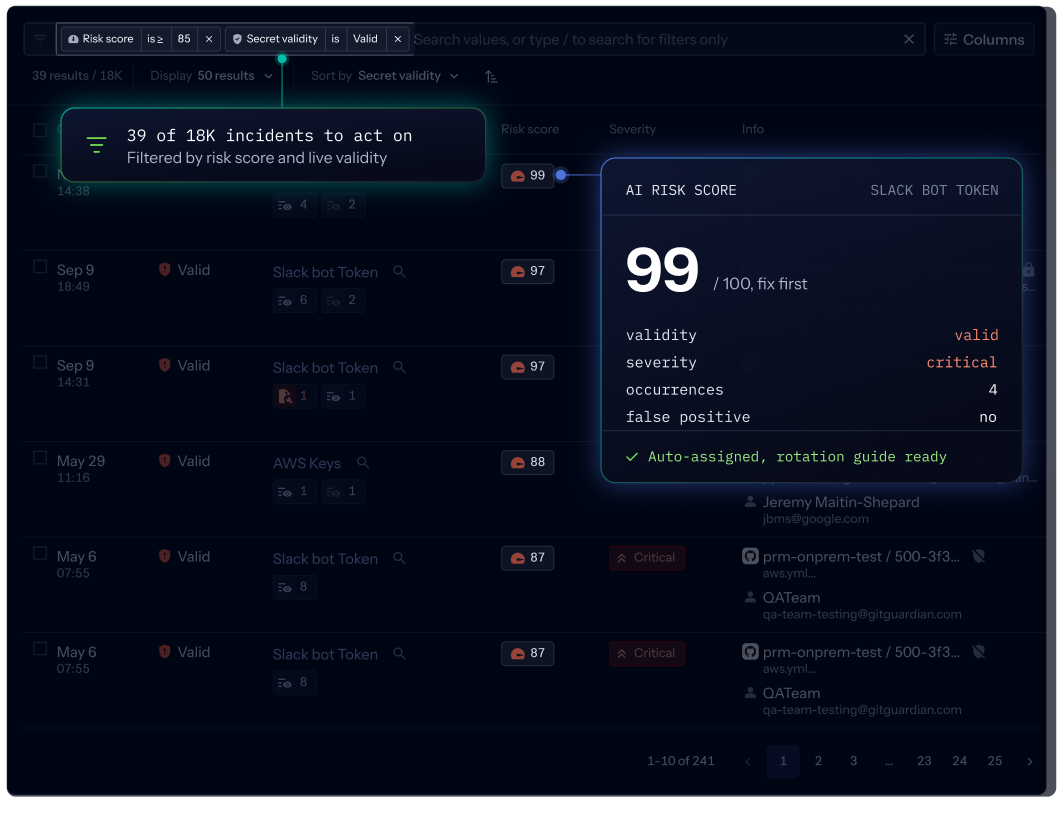
→ Prioritize high-risk incidents with AI-powered risk scoring, validity checks, and contextual analysis
→ Reduce remediation noise with context-aware false-positive filtering, occurrence grouping, and saved views
→ Auto-assign incidents with detector-specific rotation guidance
→ Native Slack, Teams, Jira, ServiceNow integrations + SIEM/SOAR webhooks
→ Accelerate remediation with automated workflows while keeping privileged actions human-in-the-loop
Stop credential exposure before it becomes another incident.
→ Block exposed credentials at pre-commit, pull request, push, and CI including in AI assisted coding environments
→ Scan MCP calls before execution and block AI agents from propagating secrets through hooks
→ Enforce multi-layer prevention across every developer workflow
→ Shrink risk at the source, not the remediation queue
%201.png)
AI security posture your board is asking about
Marketing, finance, and ops teams now ship code with AI. That code bypasses your VCS, CI, and review process. Here is how GitGuardian catches what your existing controls cannot.
See where AI credentials live
Every developer laptop now stores AI credentials in .env files, MCP configs, and agent tokens. Developer Endpoint Protection inventories every one, across the fleet.
Stop secrets from reaching AI tools
AI Hooks catch credentials before they reach Claude Code, Cursor, Copilot, or Codex, at prompt, pre-tool, and post-tool stages. Developers keep their velocity. No secret reaches the model.
Govern the identities your agents use
Agents borrow human credentials to run. NHI Governance discovers every machine identity they use, attributes ownership, scores risk.
Prove your credential risk is going down
Real reduction, not just what is easy to check. Measurable evidence for your board, auditors, and regulators.
Track the metrics that matter
Track Time to Revoke, Vault Coverage, and Exposure Window as ongoing program metrics.
.png)
Cut exposed credentials, quarter over quarter
Report reduction in exposed credentials, remediation velocity, accountability, and measurable resilience.
.png)
Every credential has a named owner
Use documented ownership and credential inventory to demonstrate control across human and non-human identities.
.png)
Built for enterprise scale

SaaS or self-hosted
Deploy in the cloud or on your own infrastructure for regulated industries.

Every credential surface
Code, CI/CD, containers, developer laptops, cloud IAM, vaults, AI tools, and collaboration platforms.

Board-ready reporting
Time to Revoke, Vault Coverage, and Exposure Window metrics your board will recognize.

Complete audit trail
12-month API retention on Enterprise. SOC 2 Type II. GDPR compliant.
Resources for security leaders

.svg)
Find your credentials before attackers do
